
The nine permanent upgrades: what coins buy, and what they never buy
Coins buy permanent upgrades for each partner, and the panel states plainly that they only count when you play with that partner. Here is all nine, what each one gives, and the order to buy them in.
What the Upgrades panel actually is
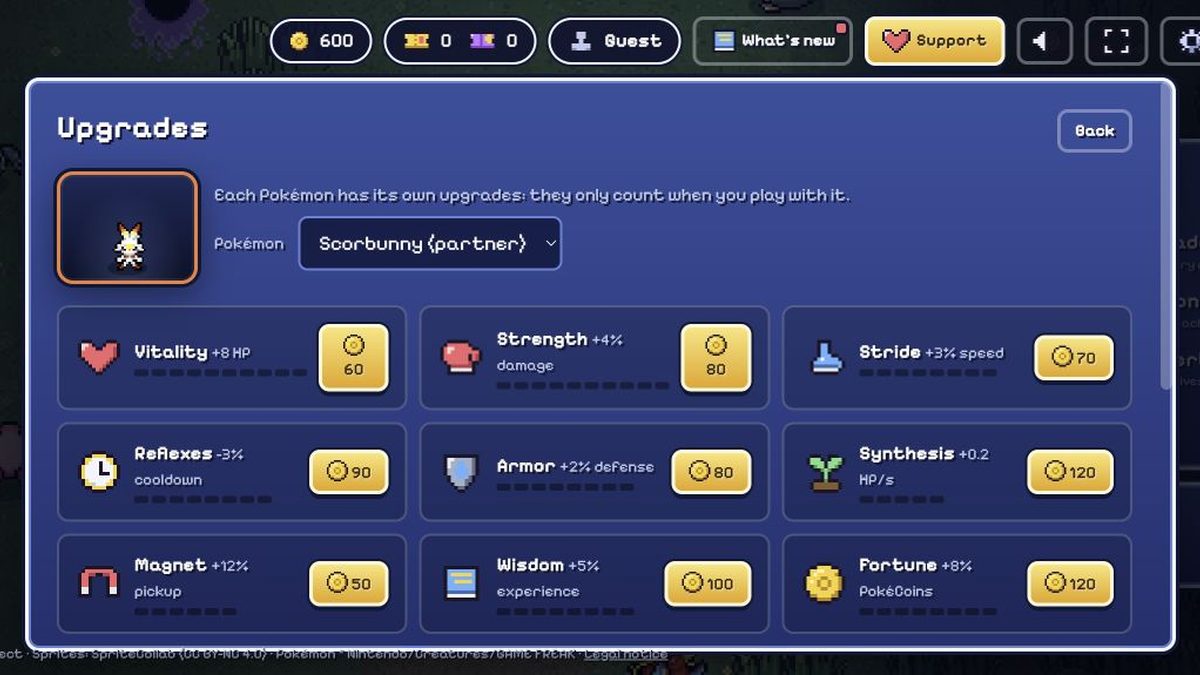
The panel opens from the main menu and it is the only place in the game where your coins go. It shows one partner at a time, nine upgrade lines, and the coin price of the next level on each. The header says it directly: each Pokémon has its own upgrades, and they only count when you play with it.
That sentence is the most important line on the screen, because it means an upgrade is not a global power boost. It is a set of nine stats attached to one specific partner. Upgrading your favourite and then switching to something else leaves the upgrades behind, still bought, still paid for, and doing nothing.
Upgrades are per partner, not per account. This is why the same partner feels weak on one account and strong on another. The difference is not skill. It is how many of its coins went into the panel on the right.
The nine upgrades
There are nine of them and they are the same nine on every partner. The values below are the ones the panel shows for a single upgrade level, along with the coin cost the panel displays for the next one at that level.
| Upgrade | What one level gives | Example cost |
|---|---|---|
| Vitality | +8 HP | 60 |
| Strength | +4% damage | 80 |
| Stride | +3% speed | 70 |
| Reflexes | -3% cooldown | 90 |
| Armor | +2% defense | 80 |
| Synthesis | +0.2 HP/s | 120 |
| Magnet | +12% pickup | 50 |
| Wisdom | +5% experience | 100 |
| Fortune | +8% Pokécoins | 120 |
Read those nine as two groups. Five of them make the partner stronger in a fight: Vitality for HP, Strength for damage, Stride for speed, Reflexes for cooldown and Armor for defence. Three of them make you more efficient outside the fight: Magnet for pickup, Wisdom for experience and Fortune for coins. The ninth, Synthesis, sits in the middle, because a small steady heal per second matters more in a long fight and less in a short one.
The costs are the interesting part of the panel. Magnet at 50 and Vitality at 60 are the cheapest entries, while Synthesis and Fortune at 120 are the most expensive. That ordering is a hint about what the game expects you to buy first, and it lines up neatly with the order of usefulness described further down.
Four of these names also appear as upgrade cards during a run. Reflexes, Armor, Synthesis and Magnet are the names of level-up cards you pick while levelling. They are a separate system: the card modifies a move for that run, the upgrade on this panel permanently raises a stat on the partner you are looking at.
What each one is actually worth
The increments are small, and that is the point. A single level of Strength is worth +4% damage, which is a rounding error in one fight and a build in fifty. The upgrades work as a compounding series rather than as individual jumps.
- Vitality is the most universal of the nine, because HP is the resource that ends runs. A partner that survives longer gets more level-ups, which gets more cards, which is the actual loop of the game.
- Strength scales with your best move, so it is worth more once you have an evolved one. Early on, the damage number is small and the coefficient barely registers.
- Stride is the quiet one. Speed decides which attacks you can dodge and which lanes you can keep, and in a game where the enemy decides where the fight happens, that is often worth more than raw damage.
- Reflexes shortens every cooldown at once, so it multiplies your whole rotation rather than one move. It is the most expensive defensive option and the one that pays off across four slots.
- Armor reduces incoming damage, which is what lets you keep playing instead of retreating to an empty corner of the map.
- Synthesis regenerates health over time, and it scales with the length of the fight. It is worthless in a rift you win in ten seconds and decisive in the minute-30 chase.
- Magnet controls how much experience and item you pick up without walking over it, which means more levels for the same amount of careful movement.
- Wisdom adds experience, and experience is levels, and levels are cards. It is the multiplier on your whole build.
- Fortune adds coins at the end of a run, and coins are what buy the other eight.
The compounding loop. Wisdom gives levels, levels give cards, cards give a better move, a better move gives more kills, more kills give more coins, and coins buy upgrades. Every one of the nine sits somewhere on that loop.
Why the upgrades are per partner
With 966 Pokémon in the game, a per-partner upgrade tree sounds like a trap, and for a new player it usually is. Spreading 600 coins across six partners at one level each produces six partners that are all slightly better than nothing.
The alternative is a short roster played properly. Two or three partners with real levels behind them will out-perform a wide collection of almost identical partners every single time, because the upgrades only apply when that specific partner is the one out there fighting.
- Pick the partner you actually use. If you always play the same starter, that is the only panel you should ever open. Every other partner on your account is a spare part.
- One partner, all nine lines. Rather than one level of everything on three partners, take one partner deep on Vitality and Strength first, then add the others.
- Add partners when a new one earns it. A rare pull or a legendary you keep dying to is a good reason to start a second panel, but not a reason to abandon the first.
The practical test is simple. If you have spent coins on five partners and you cannot name the one where those coins are actually working, the spread was wrong. The panel makes it easy to check: each partner has its own nine rows and its own level pips, and the partner dropdown at the top is the only thing you change to look at them.
What to buy first, in order
If you want a defensible order rather than a preference, start with the cheap stats that help every fight, and leave the expensive ones until the run rate supports them.
- Vitality first. It is cheap at 60 and it extends every run you play, which means more experience and more coins from the same amount of time.
- Strength second. Damage shortens fights, and shorter fights mean fewer chances to be hit.
- Stride and Reflexes next. These two are about tempo, and tempo is what carries you past the point where the horde outnumbers your ability to kite.
- Armor and Synthesis after that. Defence and regeneration are what make the late game survivable, and both scale with how long you are still alive.
- Wisdom and Fortune last. They multiply what you already have. Take them when the first five are carrying you comfortably.
- Magnet whenever it is cheap. At 50 it is the cheapest line on the panel and it quietly makes every other upgrade pay off sooner.
The order is not the only valid one. A player who enjoys a long, careful run will want Synthesis earlier, and a player who dies to burst damage will want Armor earlier. The list above is a default, not a rule.
A coin-farming route and a survival route are different runs
Two held items make the difference between a run that is about surviving and a run that is about paying for upgrades: the Amulet Coin adds +50% Pokécoins at the end of the run, and the Lucky Egg adds +30% experience. Neither makes you stronger or safer. They change what the run is worth.
A farming run accepts smaller risks, moves slower, ends earlier, and takes fewer rifts, because a rift win pays in tickets rather than coins. A survival run pushes for minute 30, takes the rifts, and ends with a smaller coin total. The trap is running one route while expecting the other result.
| Route | What you want from the run | What it looks like |
|---|---|---|
| Coin farming | Pokécoins for the upgrade panel | Amulet Coin, slower movement, early exit, no rifts |
| Experience farming | Levels for a partner you are levelling | Lucky Egg, focus on pick-ups, magnet upgrades |
| Survival | A partner that survives to the chase | Better moves, rifts taken, full 30 minutes |
Fortune multiplies whichever route you pick. It adds 8% Pokécoins per level, so it is worth more on a coin-farming run than on a survival run. That is the only place in the panel where your route changes what you should buy.
What permanent upgrades never do
There is a long list of things the upgrade panel does not do, and it is worth being explicit about them, because the panel can look like the game's main progression when it is actually one of two.
- They do not unlock new partners. Only the collection does that, through the gacha and through what you meet on the map.
- They do not unlock new moves or evolve anything. Move evolution is a run-time system driven by the cards you pick while levelling.
- They do not change the type chart, the weather, or the rift arenas. Those are fixed properties of the game.
- They do not apply to a partner you are not playing. The panel is explicit about this, and it is the rule people break most often.
- They do not survive a partner being swapped mid-run in any meaningful sense, because the panel is read when the run starts.
So the panel is a multiplier on a partner you have already chosen, and the choices themselves come from elsewhere: the gacha for new partners, the card system for stronger moves, and the achievement list for the reasons to keep playing. If you are not sure what to spend coins on, spend them on the partner you keep picking, because that is the only place they will ever apply.

Questions about this
What do permanent upgrades do in PokéSurvivor?
They raise nine stats on one partner: HP, damage, speed, cooldown, defence, health regeneration, pickup, experience and coins. They apply permanently to that partner and only while you play with it.
How many upgrades are there?
Nine: Vitality, Strength, Stride, Reflexes, Armor, Synthesis, Magnet, Wisdom and Fortune. Every partner has all nine.
Should I upgrade every Pokemon I own?
No. Because the upgrades only count when you play with that partner, spreading coins thin leaves every partner slightly better than nothing. A short roster played deeply beats a wide collection played shallowly.
What do coins buy?
Levels in the permanent upgrade panel. They cannot be bought with real money; they come from the end of a run, and the Fortune upgrade and the Amulet Coin item both increase that income.
Is Strength or Vitality better to buy first?
Vitality is cheaper and it compounds through every run you play, because more HP means more levels means more cards. Strength becomes the better buy once you have an evolved move, since it scales with your best damage.
Written for PokéSurvivor.online, an independent guide. Not affiliated with Nintendo, Creatures, GAME FREAK or The Pokémon Company. If a number here ever disagrees with the game you are playing, the game wins — tell us and we will fix the page.