
966 partners across nine regions: what a region gives you and how to choose one
Every region in the game is unlocked from the first run, with 966 playable partners in total. Here is how many each region holds, which 29 starters are available, and what a region actually changes.
Nine regions, all open from the first run
The single most common misunderstanding about PokéSurvivor is that you pick a region and progress through it. You do not. All nine regions are available from the first run, the Pokédex lists all 966 Pokémon, and every one of them can be your partner. The regions are a way of organising the roster, not a progression gate.
That changes how you should think about the first choice you make. You are not committing to a region, you are picking one partner out of 966, and the game will let you swap at any time between runs. The commitment that matters is not the region, it is which partner you decide to invest coins in.
| Region | Generation | Pokémon | Starters |
|---|---|---|---|
| Kanto | Generation 1 | 151 | 5 |
| Johto | Generation 2 | 100 | 3 |
| Hoenn | Generation 3 | 135 | 3 |
| Sinnoh | Generation 4 | 107 | 3 |
| Unova | Generation 5 | 141 | 3 |
| Kalos | Generation 6 | 70 | 3 |
| Alola | Generation 7 | 83 | 3 |
| Galar | Generation 8 | 87 | 3 |
| Paldea | Generation 9 | 92 | 3 |
The counts are not even. Hoenn and Unova are the largest regions with 135 and 141 Pokémon, and Kalos is the smallest with 70. Paldea at 92 and Galar at 87 are still large by the standards of the main games. It does not matter much in practice, because you meet partners by playing rather than by completing a checklist.
The 29 starters
There are 29 starters across the nine regions, and every one of them is available from the first run. Eight regions have the usual three. Kanto has five, and the two extras are Psyduck and Slowpoke.
| Region | Count | Starters |
|---|---|---|
| Kanto | 5 | Bulbasaur, Charmander, Squirtle, Psyduck, Slowpoke |
| Johto | 3 | Chikorita, Cyndaquil, Totodile |
| Hoenn | 3 | Treecko, Torchic, Mudkip |
| Sinnoh | 3 | Turtwig, Chimchar, Piplup |
| Unova | 3 | Snivy, Tepig, Oshawott |
| Kalos | 3 | Chespin, Fennekin, Froakie |
| Alola | 3 | Rowlet, Litten, Popplio |
| Galar | 3 | Grookey, Scorbunny, Sobble |
| Paldea | 3 | Sprigatito, Fuecoco, Quaxly |
Three starters per region is the standard shape of the main games, and the game's own starting roster follows it. Scorbunny, the starter from Galar, is the one the game gives you by default — it is the partner on the first screen and the one in the Upgrades panel.
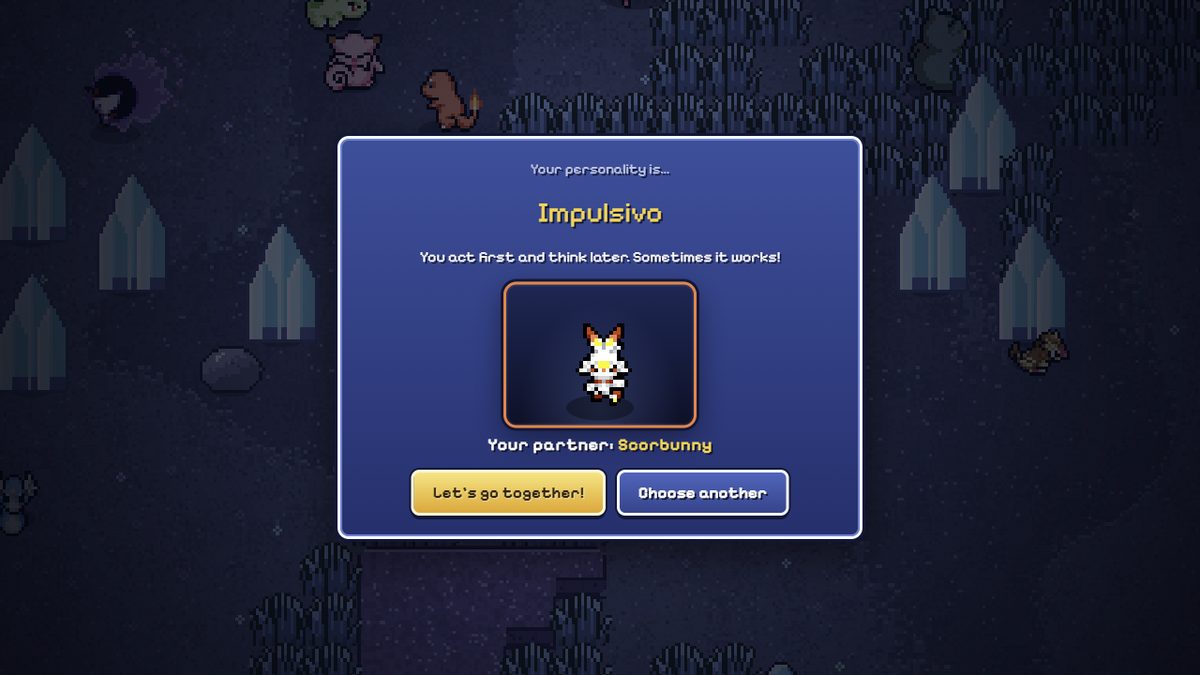
Choose for the delivery, not for the creature. Your partner attacks on its own, so what matters is how its move reaches enemies. A projectile you can walk into position with is a much better first partner than a melee move that only hits what is already touching you, no matter how rare it is.
What a region actually changes
A region is a bundle of four things: the partners in it, the types they lean towards, the gacha slot that pulls from them, and the shinies that live there. That is the whole of it.
- The partners. Each region has its own list, from 70 to 141 of them, and each one comes with its own moves and its own permanent upgrade panel.
- The type mix. Regions are not type-pure. Unova leans Fighting and Dark, Paldea leans Grass and Ghost, and Kanto covers everything, but every region reaches across most of the chart.
- The gacha. There is a slot-machine gacha for each region, and the tickets you earn are spent on a specific region's machine. This is the only thing in the game that is organised strictly by region.
- The shinies. A handful of Pokémon in each region have a shiny form, and those forms can be caught in the wild or pulled from the gacha.
Everything else is shared. The 64 moves, the 18 types, the type chart, the weather, the items, the rift arenas and the achievements are the same for all nine regions. Choosing a region does not lock you into a ruleset.
Single type and dual type partners
The roster splits almost exactly in half. 480 of the 966 have a single type and 486 have two, which is close enough to even that you should expect to meet both kinds constantly.
| Type | Pokémon with this type | Type | Pokémon with this type |
|---|---|---|---|
| Water | 149 | Fighting | 68 |
| Normal | 120 | Dragon | 67 |
| Grass | 118 | Rock | 66 |
| Flying | 102 | Electric | 64 |
| Psychic | 96 | Fairy | 62 |
| Bug | 89 | Steel | 61 |
| Poison | 78 | Ghost | 60 |
| Fire | 76 | Dark | 60 |
| Ground | 70 | Ice | 46 |
Water is the most common type in the game and Ice the rarest, a spread of more than three to one. That matters for one reason in particular: when a partner has two types, both of them are drawn from a roster where one type is common and another is scarce, so a rare type on a partner is rarer still.
Dual types also interact with the chart in the way the type chart guide describes. A partner that is Fire and Flying is not simply a Fire partner that also flies; it is a partner whose two multipliers multiply against whatever it is fighting, and whose matchups can cancel out.
The 24 that have a shiny form
Not every Pokémon in the game has a shiny form. There are 24 of them, and the list is short enough to be worth knowing because a shiny is the only permanent cosmetic in the game that you cannot buy with coins.
| Region | Pokémon with a shiny form |
|---|---|
| Kanto | Bulbasaur, Charmander, Squirtle, Pikachu, Eevee, Charizard, Mewtwo, Mew |
| Johto | Chikorita, Cyndaquil, Totodile, Lugia, Ho-Oh |
| Hoenn | Treecko, Torchic, Mudkip, Rayquaza |
| Sinnoh | Piplup, Lucario, Garchomp |
| Unova | Snivy, Greninja |
| Alola | Rowlet |
| Paldea | Sprigatito |
Two things follow from that list. The first is that the shinies you can actually collect cluster in the early regions, which is where a lot of players spend their first hundred runs. The second is that Galar and Kalos have no shiny-capable Pokémon in the list at all, which is worth knowing before you plan a shiny hunt around a region you like the look of.
The odds are the odds. A shiny appears in the wild at 1 in 4096 and in the gacha at 1 in 100, and a duplicate shiny is worth triple Pokécoins. Nothing about a partner changes those numbers.
Why one partner is worth all your coins
Every partner has its own permanent upgrade panel, and the panel states plainly that those upgrades only count when you play with that partner. With 966 partners available, this is the part of the game where a new player wastes the most coins.
The reasoning is straightforward. A partner with real upgrades behind it will outperform a partner with one level of everything, every time, because the upgrades are a flat bonus on top of a move set you already know how to play. A wide collection of unupgraded partners is a museum, not a team.
So the practical order is: pick the partner whose move you can actually aim with, learn its upgrade card, and pour coins into that one panel. Add a second partner when something better shows up in the collection. That is the whole progression in one sentence, and the upgrades guide has the priority order for the nine stats.
The regional gacha
Every region has a slot-machine gacha and tickets are the only currency that feeds it. Tickets cannot be bought with real money. Regular Pokémon drop tickets now and then, and bosses and rift legendaries sometimes drop ×10 tickets, which makes a rift win worth ten ordinary pulls.
Because the machine is tied to a region, the decision of which machine to feed is a real one. Tickets spent on a region whose Pokémon you cannot use are gone, so the sensible order is to feed the machine for the region where your starter lives, then the one where your type coverage is thinnest.
Tickets do not roll partners you already own. A pull gives you a Pokémon from that region, and duplicates are worth coins rather than nothing, so a machine you have already drained still pays in the long run.
When a new partner arrives
The collection will hand you partners faster than you can use them, and the natural reaction is to try them all. That is usually a mistake, because a partner with no upgrades behind it is worse than the partner you have been investing in, and switching costs you the familiarity you have built up.
- Look at the types first. A new partner is worth taking seriously if its type covers a gap in your current partner, particularly if its two types sit on opposite sides of the chart. A duplicate of the type you already have is a roster filler.
- Look at the move second. What actually fights is the move, not the creature. A partner with a move you cannot aim is worse than a common one with a projectile you can lead with.
- Do not upgrade it yet. The upgrade panel is per partner, so opening a second panel at level zero is the exact mistake the panel warns about. Leave it at zero until you are ready to play it regularly.
- Wait for the coins. The upgrade levels get more expensive as they go, so a partner you adopt in month one and a partner you adopt in month six cost very different amounts to bring up to the same level.
The exception is a partner you have a reason to be excited about. If something in the collection is the legendary you have been failing to beat in a rift, or the shiny form of a partner you already use, then that is a good reason to start investing in it early, because the payoff is specific rather than vague.
Roster depth is a goal, not a strategy. Owning more partners is worth something because it opens the Pokédex and the collection achievements. It is not worth much in a fight, because a fight is won by one partner with its upgrades behind it.
Questions about this
How many Pokemon does PokéSurvivor have?
966, across all nine regions from Kanto to Paldea. All of them are playable as your partner, with their shiny form where one exists.
Are all regions unlocked from the start?
Yes. There is no region gating and no level requirement. Every region's starters are available from the first run.
How many starters are there?
29. Eight regions have three each, and Kanto has five: the usual three plus Psyduck and Slowpoke.
Which Pokemon have shiny forms?
24 of them, listed in the section above. A shiny appears in the wild at 1 in 4096 and in the gacha at 1 in 100.
Do I need to upgrade every Pokemon?
No, and you probably should not. Permanent upgrades only count when you play with that partner, so a small roster with real upgrades behind it is stronger than a wide collection with one level each.
Written for PokéSurvivor.online, an independent guide. Not affiliated with Nintendo, Creatures, GAME FREAK or The Pokémon Company. If a number here ever disagrees with the game you are playing, the game wins — tell us and we will fix the page.