
Missions, medals, titles and your public profile: what the game tracks
Daily and weekly missions, the medals and titles behind the 130 achievements, the public profile, leaderboards, friends list and why an account matters more than any of them.
What the game tracks
Underneath the survival game there is a tracking layer that runs the whole time: daily and weekly missions, the 130 achievements with their medals and titles, a public profile, leaderboards, a friends list, and the two currencies you spend in two different shops. None of it requires you to be good at the game, which is exactly why it is worth understanding.
The missions are the engine. They are the only part of the tracking layer that asks you to do something on a schedule, and they are the engine behind the mission achievements, the coins and the tickets that everything else is bought with.
Daily and weekly missions
The game lists daily and weekly missions, and the achievement list gives you the shape of the track. Three achievements count completed missions at three different scales.
| Achievement | What it asks for | Title |
|---|---|---|
| Reliable | Complete 10 missions | — |
| Steady | Complete 50 missions | Steady |
| Tireless | Complete 200 missions | — |
That is the whole of the published information about missions: they exist, they come in daily and weekly form, and completing them is counted. The game does not publish a list of what every individual mission asks for, and the exact set rotates, so treat the mission panel itself as the source of truth for what is on offer today.
Missions are the reason to log in on a bad day. A run that ends badly still moves a mission forward. That is what makes the daily list worth checking before you decide whether to play at all.
Two of the achievements attached to missions are co-op rather than task based, and they sit in the same category for a reason: playing with other people is a separate axis of progress from playing well.
Medals and titles
Every one of the 130 achievements gives a medal and a reward, and the hardest ones also give a title. A title is not a stat. It is a label attached to your profile that says something about what you have done.
Twenty-one of the achievements on the list carry a title, and they are spread across every category rather than clustered at the top. Collector, Brilliant and Shiny hunter sit in the collection category. Judged and Chosen of Arceus sit in survival. Brave and Rift traveler sit in the rifts. Antiguarian sits in combat. Steady and Loyal partner sit in missions.
What that tells you is that the title system is a way of showing breadth. A profile with five titles is not a profile with five medals; it is a profile with five different kinds of achievement, which reads very differently from five achievements in the same category.
The achievements themselves are permanent and are checked against your account rather than against a single run, so they keep working while you are doing something else entirely. A run that goes badly still adds kills, bosses, items and missions.
Your public profile
The profile is where the collection, the achievements, the titles and your current partner meet. It is also what the leaderboard and your friends see.
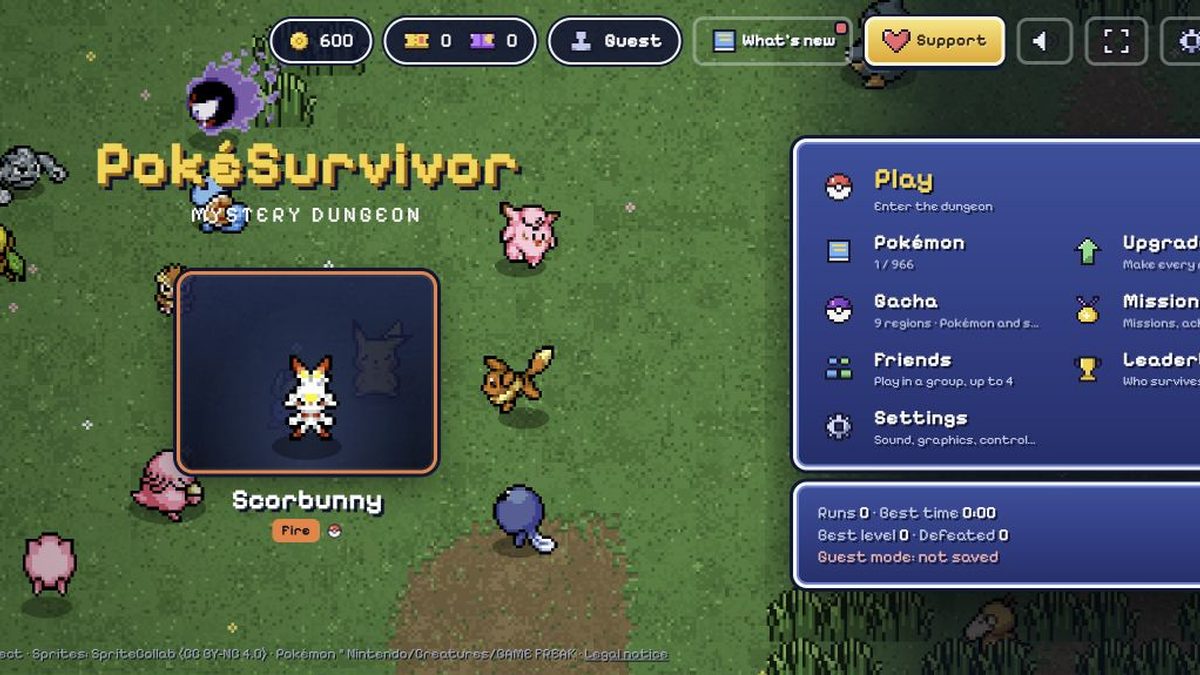
Two things about it are worth knowing. First, it is public, which means the titles and the collection are visible to other players — that is the point of the system, and it is why the achievements are worth finishing even if you never look at them yourself. Second, it is tied to your account, so it only fills up if you are signed in.
Leaderboards and the friends list
Online co-op supports up to four players. You add friends by nickname, invite them to your room, and start the game together. Experience is shared between the party, and a fallen teammate can be revived by standing next to them.
Rooms connect peers directly when they can, which is the one practical thing to read before you play with strangers: a room may work differently from your own network, and that is a connection difference rather than a rules difference.
Two achievements track this side of the game.
| Achievement | What it asks for | Title |
|---|---|---|
| In good company | Play a group game | — |
| Loyal partner | Play 10 group games | Loyal partner |
Co-op is a genuine progression axis. Two achievements, a title, and a completely different way to play the same game. If you have never played with other people, this is the least effort per achievement in the whole list.
The two currencies, and what each one buys
The game has two spendable currencies and they are not interchangeable, which trips up new players more than any other mechanic.
| Currency | Where it comes from | What it buys |
|---|---|---|
| Pokécoins | Earned at the end of a run | Levels in the permanent upgrade panel |
| Tickets | Dropped by Pokémon, and ×10 from bosses and rift legendaries | Pulls in the regional gacha |
Coins come from the end of a run and nothing else, and the Fortune upgrade adds 8% to them while the Amulet Coin held item adds 50% at the end of the run. Tickets come from drops during a run, and a rift win is worth ten of them. The gacha is the only sink for tickets and the upgrade panel is the only sink for coins, so neither currency can be spent on the other's shop.
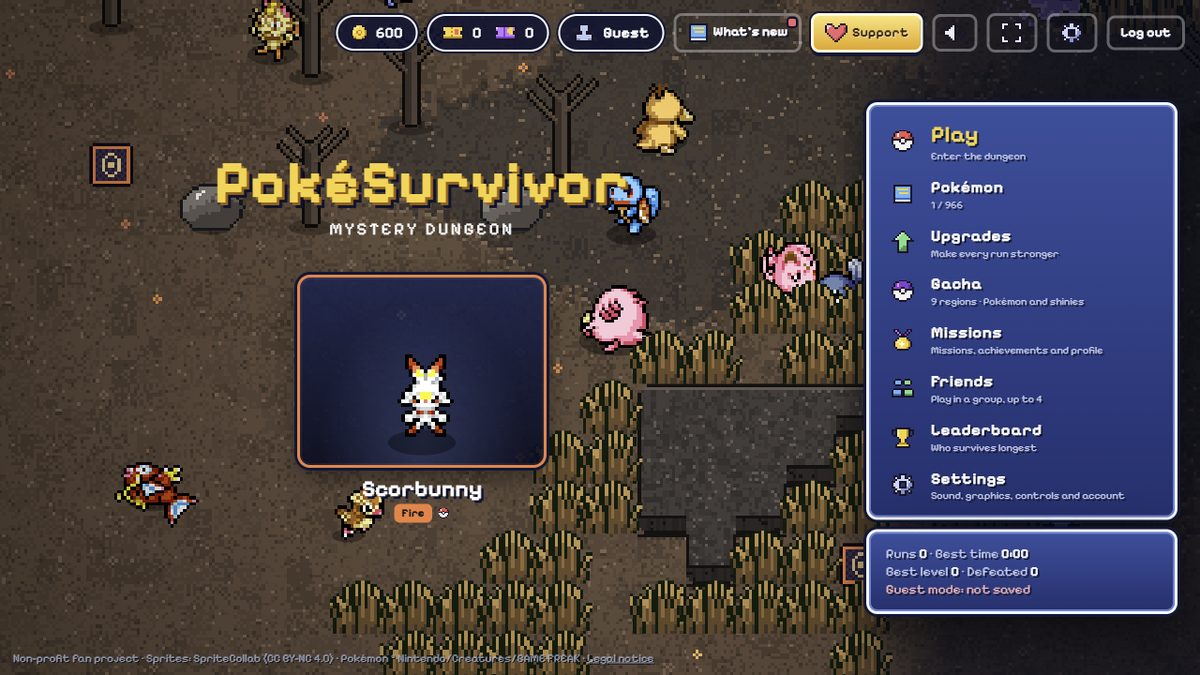
Tickets cannot be bought with real money, and neither can coins. The game is free, has no ads and no purchases, and the only optional spend is a voluntary donation that pays for the servers and gives no advantages.
Saving your progress is the one decision that matters
With an account, using a nickname and password or Google sign-in, the game is saved in the cloud and you can continue on any device. As a guest you can play right away and nothing is saved.
That single difference decides what every other system on this page is worth. Missions, achievements, medals, titles, the profile, the leaderboard, the collection, the coins and the upgrade levels are all stored against the account. A guest session can earn all of them and lose all of them when the tab closes.
Create the account first. It takes about a minute, it is the only irreversible decision in the game, and everything else on this page can be rebuilt by playing.
The game can also be installed as an app with Add to Home Screen, which is the same account on the same servers. It follows your browser language between English and Spanish, with a switch in Settings, and it runs on PC, tablet and phone in landscape.
Setting up a new account in the right order
There is an order that makes the first week much less wasteful than another, and it takes about ten minutes in total.
- Create the account first. Sign in with a nickname and password or with Google before you do anything else. Everything after this point attaches to it, and a guest session loses all of it.
- Take the quiz and pick a partner. The four questions take a minute. Do not agonise: you can change the partner later, and the permanent upgrades are what you should be careful about, not the first choice.
- Check the missions before you play. The daily and weekly list is the part of the tracking layer that expires, so it is worth reading before you settle into a routine. The missions you do not finish are the ones that roll over.
- Play one normal run and ignore everything else. Your job in the first run is to learn the controls and see a level-up card. You will not have an item, a rift win or a plan.
- Spend the first coins on the partner you played. Not on the one you like most in the collection — on the one you just used. Coins on a partner you do not play are the single most common waste in the game.
- Set the language and the sound now. The game follows your browser language and can be switched in Settings. Doing it once here means you are not hunting for the toggle later.
After that, the loop is simple and stable: check the missions, play a run, take a rift or two when the build is strong enough, spend the coins on the partner you used, and pull the gacha with the tickets. The collection fills in the background whether or not you are chasing it, and the achievements tick over on their own as long as you keep playing.
Nothing here needs to be optimised on day one. The game is a non-profit fan project with no purchases and no competitive pressure. The only thing that is genuinely hard to undo is not creating an account, and everything else can be rebuilt by playing.
Questions about this
What are daily and weekly missions?
Tasks the game lists that you complete for rewards. The achievement list counts them at three scales: 10 for Reliable, 50 for Steady and 200 for Tireless. The game does not publish the full mission pool, so the mission panel is the source of truth for what is on offer.
What do medals and titles do?
Every achievement gives a medal, and 21 of the 130 also give a title. A title is a label on your public profile, not a stat that changes your partner.
Does my progress save without an account?
No. A guest session saves nothing, so missions, achievements, coins and collection are all lost when the tab closes. With an account the game saves to the cloud and continues on any device.
Can I play with friends?
Yes, up to four players. Add friends by nickname, invite them to your room and start together. Experience is shared and you can revive a fallen teammate by standing next to them.
Is anything in the game behind a payment?
No. There are no ads and no purchases, and tickets cannot be bought with real money. The only optional spend is a voluntary donation that covers the servers and gives no advantages.
Written for PokéSurvivor.online, an independent guide. Not affiliated with Nintendo, Creatures, GAME FREAK or The Pokémon Company. If a number here ever disagrees with the game you are playing, the game wins — tell us and we will fix the page.